
When Google shows an AI summary, people click a traditional search result in only 8% of visits. When it doesn’t, they click in 15%. That comes from a Pew Research Center study of 900 U.S. adults, and it is why GEO and AEO keep showing up in marketing meetings. They are perceived as a new channel to replace declining organic search. But the reality is more nuanced.
The trouble is that people use GEO and AEO as if they mean the same thing, and vendors sell them as the end of SEO. Explanations often skip how an AI answer actually gets built (which is important to understand).
This article covers what each term means, how retrieval works, why the labels blur and where the work differs from SEO a decade ago. It also covers what your own website cannot do for you.
SEO, AEO and GEO in plain terms
Let’s a play a game now. Imagine that a search engine is a librarian. SEO is the work of getting your book onto the right shelf, so that people browsing that shelf can find it.
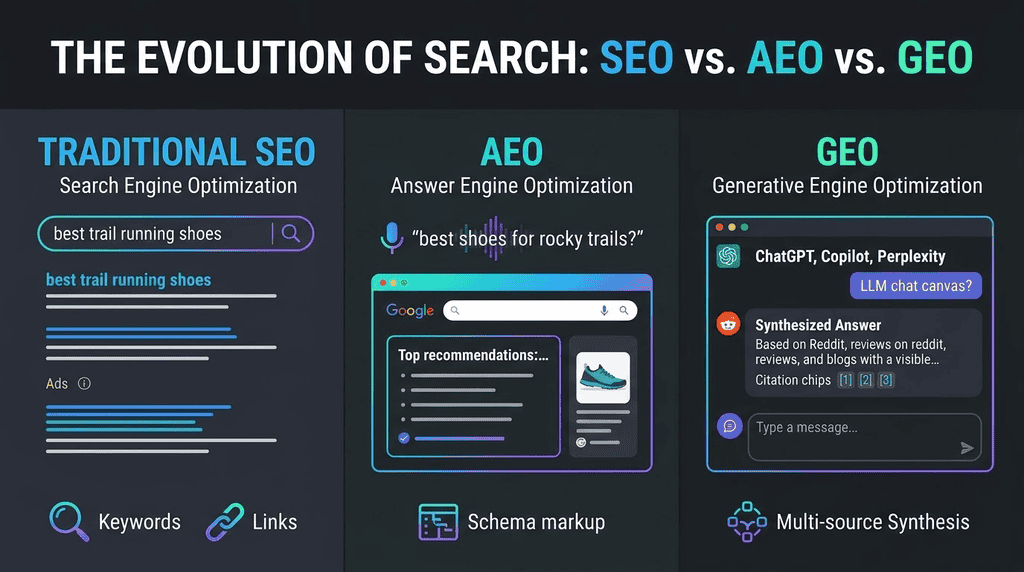
AEO, short for answer engine optimization, is the work of making your content the answer the librarian reads aloud. GEO, short for generative engine optimization, is the work of getting the librarian to pull your content before writing a fresh summary, then to credit your page or name in it.
Figure 1 puts the three side by side. They describe different outcomes, and the rest of this article shows where they overlap.
How GEO retrieval works
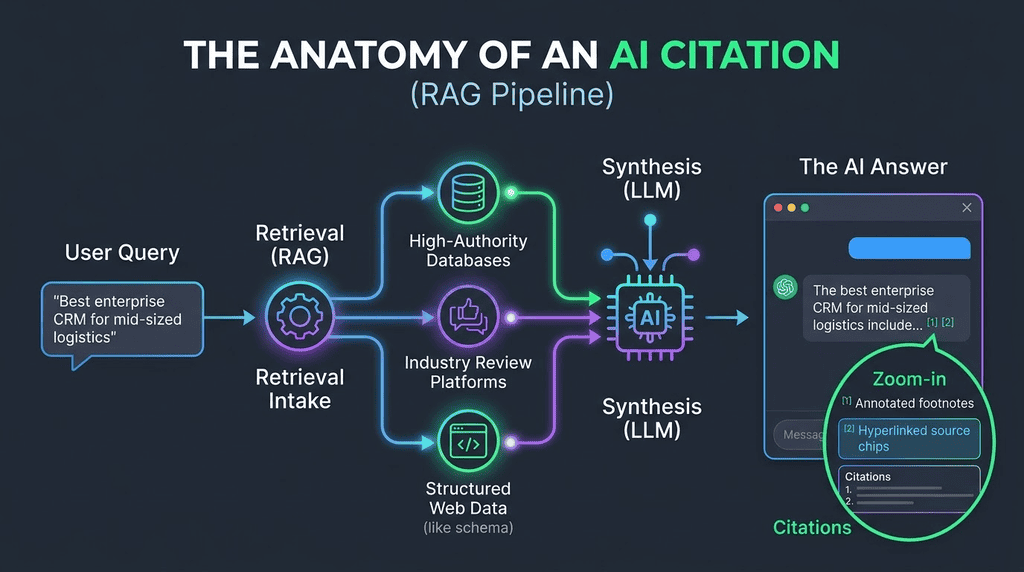
Engineers call the pattern behind web-grounded AI answers retrieval-augmented generation, or RAG. The system retrieves material first, then generates an answer from it. Figure 2 follows one question through that process: “best enterprise CRM for mid-sized logistics.”
The four steps
Everything starts with the query. The system reads the question and decides what to look up. Google says its AI features may run “multiple related searches across subtopics and data sources,” a technique often called query fan-out. For the CRM question, that could mean separate lookups for pricing, logistics features and reviews.
Retrieval comes next. The system pulls candidate pages and passages from the sources it can reach. The figure groups them into high-authority databases, industry review platforms and structured web data.
Synthesis follows. A large language model (LLM) like ChatGPT reads the retrieved material and writes one answer in its own words. Your content can shape that answer without being named, and a retrieved page can still be left out.
Last come the citations. Many AI answers attach footnotes or source chips, as the zoomed panel of the figure shows. Those links are the part you can count.
AEO then and now
AEO is older than generative AI. Search Engine Watch said in 2018 that the rise of voice search was “transforming search engines into ‘answer engines,'” and it named the resulting strategy AEO. Back then, AEO meant winning the featured snippet at the top of the results page or being the answer a voice assistant read aloud.
You could not simply mark up a page to win that spot. Google’s featured snippets documentation says its systems decide, and on marking a page for one, the answer is “You can’t.”
Today the label has stretched. HubSpot’s glossary says effective AEO means making content “clear, authoritative, and well-structured enough that answer engines select it as a cited source.” That goal is about AI systems citing you, which is the ground GEO covers.
In this article, AEO means the direct-answer idea and GEO means the generated-answer idea.
Why GEO and AEO get used as one thing
The blur starts with the answer itself. Take a question like “what is a content audit.” When Google answers it with an AI Overview, the response gives a direct answer, which is the AEO job. It also builds that answer from several pages and links to them, which is the GEO job.
A chat assistant works the same way. Ask it which CRM suits a mid-sized logistics firm and you get a short recommendation (which is the AEO side), assembled from retrieved sources (he GEO side). So one response carries both labels.
The two ideas still come apart in two cases. A featured snippet on Google lifts one passage from one page with no generation at all, so it is AEO without GEO. An AI answer can also name your brand from a third-party review roundup with no link to your site, which is GEO without a visit.
Google’s guide says that, from Google Search’s perspective, “optimizing for generative AI search is optimizing for the search experience, and thus still SEO.” Well, the outcomes still differ, because ranking, being quoted and being recommended are separate events, and each needs its own tracking.
How it’s different from what SEO was ten years ago
SEO has not gone away fully, though. But four habits from the mid-2010s no longer describe the whole job. Here is how it all changed.
From keywords to questions
A decade ago, a common move was one page per keyword variation: “CRM for logistics,” “logistics CRM software” and “best CRM for logistics companies.” Each page repeated its phrase at a target density. Today AI systems read the question, not the phrase, and one question can trigger several lookups. In other words, a thorough page on the whole topic can serve several of them, while three thin near-duplicates compete with each other.
From links to mentions
Link building used to center on getting links, often with the exact keyword as the anchor text. AI answers draw on what others say about a brand across the web. Google’s guide says its generative AI features “can show what’s being said about products and services across the web.” This means that an unlinked mention in a trade article may carry weight, too.
From ranking to inclusion
Page one used to be the finish line. Ahrefs looked at about 863,000 keyword results pages and found that 37.9% of URLs cited in AI Overviews also appeared in the first 10 blocks.
An earlier Ahrefs study put that figure near 76%, but the method changed between studies. Ahrefs suspects query fan-out, because Google may be pulling from the results of sub-questions. Either way, a top-10 rank is clearly not a requirement today for LLM retrieval.
From clicks to visibility
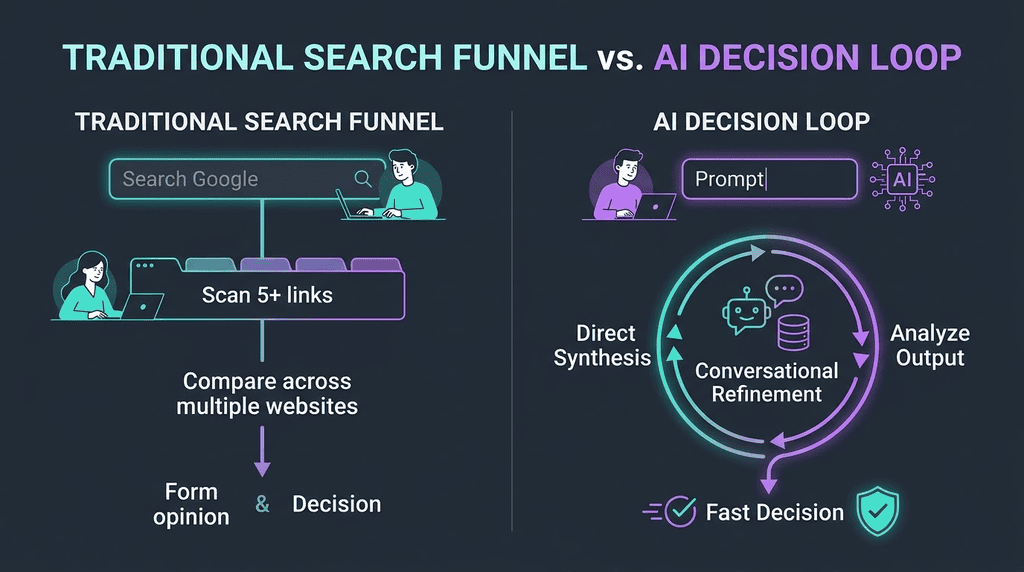
Success used to mean a click. Pew’s data shows why that is harder now. Users clicked a link inside an AI summary in just 1% of visits that showed one, and they ended their browsing session after the search page in 26% of visits with a summary, against 16% without.
Figure 3 sketches the two paths.
SEO vs GEO and AEO at a glance
The table sorts the work into three kinds: overlap, partial overlap and real difference.
| Area | Classic SEO | GEO and AEO | Overlap |
|---|---|---|---|
| Main goal | Rank pages in organic results | Be used, cited or named inside a direct or generated answer | Partial: both start with being found |
| What competes | Whole pages | Passages, claims and brands | Differs |
| Query style | Keywords and phrases | Full questions, often split into several lookups | Partial |
| Eligibility | Crawlable, indexable pages | Same for Google. OpenAI’s search crawler must be allowed for ChatGPT search | Overlaps |
| Content quality | Useful, original, satisfying to visitors | Same, plus answers that make sense when quoted alone | Overlaps |
| Page structure | Clear headings and internal links | Clear headings plus answer-first passages with conditions attached | Overlaps |
| Authority signals | Links to your pages | Links plus mentions across third-party sites | Partial |
| Structured data | Supports rich results where eligible | Google says it is not required for generative AI search | Differs |
| Success measure | Rankings, clicks, conversions | Citations, mentions, recommendations, referral visits | Differs |
| Stability | Positions you can check repeatedly | Answers vary from run to run, so you must sample | Differs |
| Control | Direct: edit the page, request indexing | Indirect: you influence what gets retrieved, with no guarantee | Differs |
| Where the work happens | Mostly your site and links | Your site plus review sites, press, communities and profiles | Partial |
The same text written two ways
Here is a short piece on a question every marketing manager gets: how long SEO takes. Version A follows the keyword-led habits described above [traditional SEO]. Version B is written for LLM retrieval.
Version A: written for rankings
How long does SEO take? It is one of the most common questions in search engine optimization, and the answer depends on many SEO factors. In this guide to how long SEO takes, we cover SEO timelines, SEO results and the SEO strategy that helps you rank.
Many websites see SEO results after several months. The SEO timeline depends on your competition, your domain authority, your content and your backlinks. A new website usually needs more time than an established website.
To speed up your SEO results, focus on keyword research, on-page SEO and link building. Optimize your title tags, headings and meta description around the phrase “how long does SEO take,” then build quality backlinks and publish new content on a regular basis.
Version B: written for retrieval
SEO usually takes between 3-6 months to show measurable results for a new site. The exact time depends on three things: how competitive the topic is, how much useful content the site already has, and how easily search engines can crawl its pages.
Results arrive in these stages. Pages get indexed first, then start ranking for narrow, low-competition queries, and only later earn traffic for competitive terms. You should also agree with your team on which stage counts as a result before you start the clock.
For example, a B2B software client we started working with in January 2025 saw its first ranking gains for long-tail queries in March, measured by average position in Search Console, and reached page one for its main category term by August.
Google’s AI optimization guide also tells publishers to “continue prioritizing foundational SEO best practices,” so the same work that earns rankings keeps pages eligible for AI answers.
What changed and what did not
Version B answers in its first sentence – this is to help retrieval systems lift that sentence without the rest of the page. It also keeps conditions next to the claim, such as “for a new site” and the three factors for a quoted fragment to stay accurate.
It defines what a result means, which fixes the vagueness of “after several months” in Version A. And it carries first-party data and a named source, close cousins of the statistics and quotations the GEO paper tested.
In that benchmark, adding statistics raised an impression score by up to 37% in a 200-query Perplexity test. The authors supplied the source text, though, for the result not to show that a page on the open web.
Version B keeps what still works from SEO: a clear topic and crawlable text.
Limits of onsite optimization
What onsite work covers
Onsite work gets you eligible and gives retrieval something worth quoting. Google’s guide tells publishers to “focus on developing unique, expert-led content that provides value beyond common knowledge.” That means crawlable, indexable pages with original, accurate content and conditions kept beside the claims.
It cannot decide which sources an engine trusts for a given question, whether you are retrieved at all or whether your brand gets named. A perfect page still competes with everything else the system can pull.
Limits that apply to every tactic
Answers may change quickly. Ahrefs tracked 37,505 citations across five AI tools for 20 days. By day two, 50% of the citations Google AI Overviews gave on day one were gone, and so were 59% of ChatGPT’s.
The preferred sources change too. Semrush tracked citations weekly from July to October 2025 and saw ChatGPT’s use of Reddit fall from roughly 60% of responses in early August to about 10% by mid-September.
Google also disputes the idea that traffic is collapsing. In August 2025, Liz Reid, Google’s head of Search, wrote that total organic click volume was “relatively stable year-over-year.” That claim is self-reported, about 15 months old and comes without query-level detail.
Why onsite is not enough, and what to do externally
What the evidence says
For many questions, the best source isn’t always your site. A question that asks for the best option invites comparisons, reviews and discussion, and a vendor’s own site is rarely the neutral voice for that.
In a May 2025 Ahrefs study of 75,000 brands, branded web mentions had the strongest correlation (0.664) with brand visibility in AI Overviews. Backlinks scored 0.218. Brands in the top quartile for mentions averaged 169 AI Overview mentions, against 14 for the next quartile down.
Semrush’s analysis of more than 100 million AI citations found Reddit, LinkedIn, YouTube and Wikipedia among the most-cited domains. The mix varied by platform. LinkedIn appeared in nearly 15% of Google AI Mode responses, while Reddit and Wikipedia led for ChatGPT.
What to do beyond your site
The below steps can help gain more visibility for your brand externally.
Start by publish something worth citing. A logistics software company could survey dispatch teams once a year and pitch the findings to trade publications, because journalism is a visible share of what AI answers cite.
You can join the conversations your buyers already have. Answer questions with real expertise in industry forums, Reddit threads and LinkedIn groups. Google’s guide says seeking inauthentic mentions “isn’t as helpful as it might seem,” so we don’t recommend engaging in any astroturfing activities.
Instead, keep your review and comparison profiles accurate.
Claim your listings on the sites where your category gets compared, and ask satisfied customers for honest reviews.
Another important approach is to make your brand easy to recognize. Use the same name and description across your LinkedIn page, directories and, for local businesses, your Google Business Profile, which Google says can help visibility in AI responses.
How to tell whether it is working
Measurement is the weakest part of this field as of 2026-2027, but nonetheless here are some tools that should help measure AI visibility for your brand.
Six groups of tools
- Search engine webmaster reports. Google and Bing now report on how your pages appear in AI features. Google’s report shows impressions for links in AI Overviews and AI Mode, and its help page describes no click data. Microsoft launched a similar report in public preview in February 2026.
- Web analytics. Referral reports show visits from AI assistants that pass referral data. They can undercount, because not every AI visit arrives labeled.
- Prompt-sampling and AI visibility trackers. These run a fixed set of questions on a schedule and log which sources and brands appear. Google’s guide warns that “No third-party tool has access to our internal ranking or AI systems.” This would mean that the output should be read as samples and any guarantee of citations should be viewed with suspicion.
- Brand and media monitoring. These track press coverage, review-site listings and community threads, which is the off-site side of the work.
- Server log analysis. Logs show whether AI search crawlers fetch your pages. A blocked crawler cannot fetch a page, though a fetch is not a citation.
- Customer-reported attribution. A “how did you hear about us” field and notes from sales calls catch buyers an AI assistant influenced who never clicked a tracked link.
How to run it
Start with a fixed list of real customer questions, split into branded, category and comparison questions. Run them on a schedule at the same settings, and record the date, the answer and the sources shown.
Then score three things separately: whether your site was cited, whether your brand was mentioned and whether you were recommended. Count wrong statements about you too, even when your brand appears.
Compare changed pages with similar pages you left alone, and log other releases. If both groups move together, your edit probably isn’t the cause.
Give it weeks (don’t expect it will work within days) and report the sample size next to every figure.
The bottom line
In summary, GEO and AEO don’t replace SEO. They extend it to places your website cannot reach on its own. Start by fixing your pages first, earn your mentions next and measure everything the same way every time.
To see where your own site stands today, try our free GEO and AI Visibility Readiness Score. It is a two-minute questionnaire that rates your site’s AI readiness.