
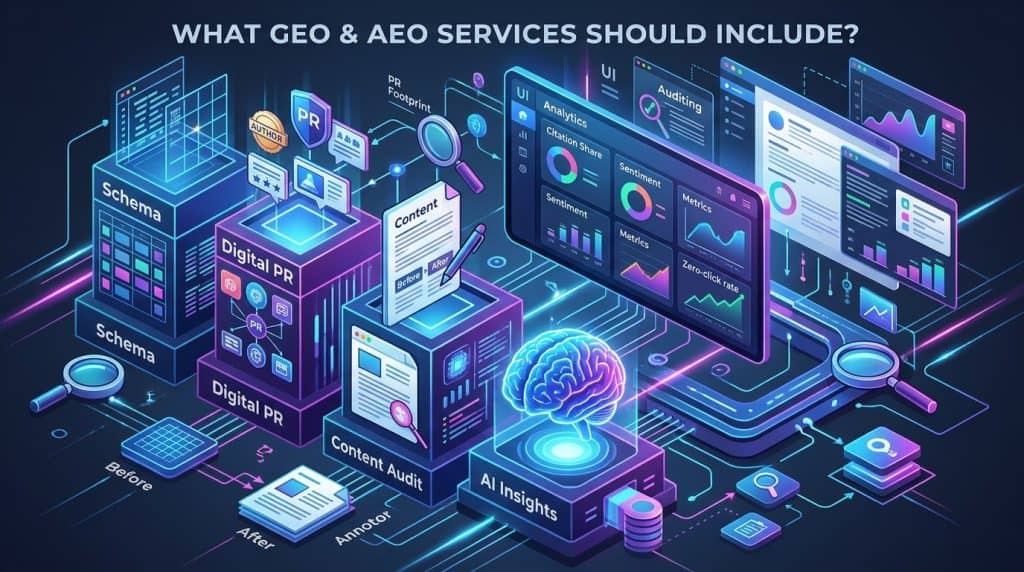
Anyone can sell you GEO right now. Unfortunately, plenty of what’s on offer is a dashboard with an invoice attached.
That’s the trouble with a field this young. The labels (GEO, AEO, AI SEO) have no agreed scope, so two agencies can quote you similar monthly fees and ship completely different work. One tracks mentions in ChatGPT and emails you a PDF. The other rewrites your pricing page, fixes what the crawlers can’t reach, and corrects what a review site says about you.
I do this work as a freelance consultant, with that, weigh my bias accordingly. These rules apply to me as much as to any big agency. I’d rather you hire a competitor who ships real deliverables than hire anyone who can’t show you one.
This guide covers what the work should include, what good output looks like, how results get measured, what it costs, and the questions that separate a practitioner from a pitch deck.
GEO and AEO: What You’re Actually Buying
Here’s the cleanest split I can give you. AEO is about answering a specific question. GEO is about how a generative system pulls sources together, cites pages, and decides which brands to recommend.
Take a software company. An AEO job starts with a buyer asking “Does this tool support SSO?” The fix is a help page that answers it directly, with plan limits and setup details. A GEO job starts with “Which tools support SSO for a 50-person team?” Now you test the question across several assistants, strengthen the proof on your own pages, and repair the gaps in the sources the engines keep citing.
In practice the line blurs. One Google AI Overview can explain a concept, cite your documentation, and name three competitors in the same box. Agencies know it, which is why most sell both under “AI search optimization” or “AI SEO.” Google itself files optimization for its generative features under plain old SEO.
First off, don’t hire on the acronym. Hire on the sentence in the contract that names the surface (Google AI Overviews, ChatGPT Search, Perplexity, Bing Copilot) and the outcome you’re paying for. If the proposal says “improve AI visibility” and stops there, send it back.
I broke down where the two overlap and where they split in GEO vs AEO: differences and similarities. The short version: both extend SEO, neither replaces it, and your website alone can’t deliver either one. Engines lean on sources you don’t control.
What a Real Engagement Ships
Ask every provider for a sample deliverable. Don’t accept case studies. A sample: a baseline export, an issue log, a content brief. If they can’t produce one, you’re just buying a promise.
A proper engagement breaks into five workstreams:
| Workstream | What the provider does | What you receive |
|---|---|---|
| Discovery and baseline | Maps customer questions by intent, market and product, using sales calls, support tickets and search data. Benchmarks named competitors and records which sources the engines cite. | A prioritized question and prompt inventory, a target page map, a dated baseline, raw answer samples |
| Technical eligibility | Tests index coverage, canonical URLs, internal links, rendered text, robots and snippet controls, and whether your CDN or firewall blocks crawlers. | A URL-level issue log with severity, fix, owner and retest evidence |
| Owned content | Updates the pages buyers actually use: product, pricing, comparison, help. Adds direct answers, limits, dates and expert evidence. | Approved briefs, live URLs, evidence links, a named fact-checker and maintenance owner |
| External sources and brand facts | Finds the third-party sources engines lean on. Fixes inconsistent product details and listings. Pursues reviews, partner documentation and editorial coverage. | A source map, corrected records, an outreach log, links to placements |
| Measurement and iteration | Runs a repeatable prompt panel, reviews platform data, ties referrals to business outcomes, and chases down misstatements. | A report with raw exports, denominators, before and after views, a change log, the next test backlog |
Here’s a quick test for the technical row. Ask which crawlers the agency actually checks. ChatGPT Search relies on OAI-SearchBot, which OpenAI controls separately from GPTBot (the crawler tied to potential model training). In other words, a site can allow one and block the other. Perplexity splits PerplexityBot, which supports search indexing, from Perplexity-User, which fetches pages when a person asks. If a provider can’t tell you which of those your firewall is blocking, they haven’t looked.
Agencies like to squeeze all of this into four pillars. The graphic below is a fair shorthand, as long as you know how it maps back to the table.
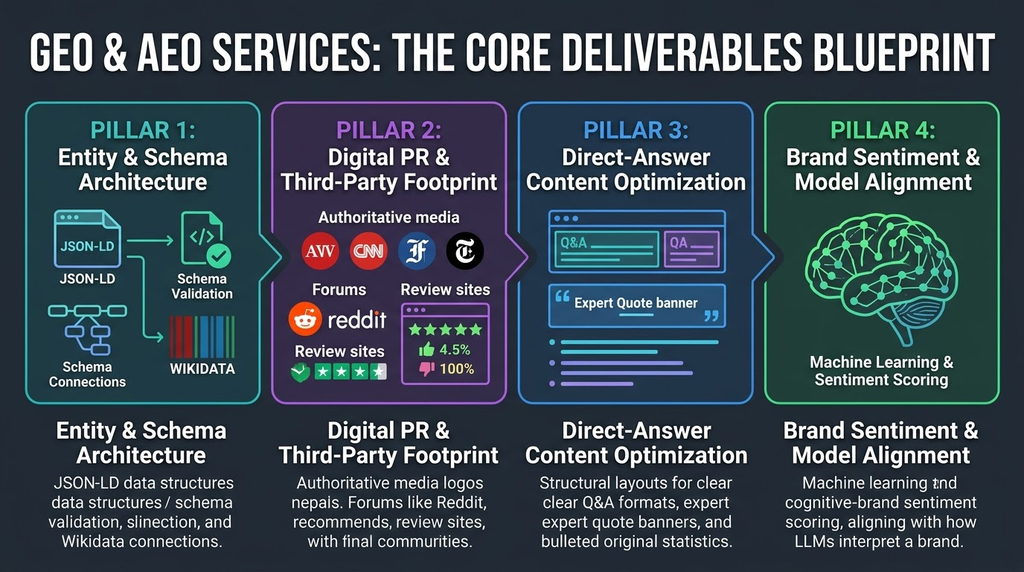
Entity and schema work lives inside technical eligibility. Digital PR and third-party footprint is the external sources line. Direct-answer content is owned content. Brand sentiment is something you check in the baseline and keep checking in measurement.
Well, the graph is detailed, but there are a couple of minor nuances.
First, schema. Google says plainly that you don’t need special markup, AI text files or any particular schema.org data to appear in AI Overviews or AI Mode. Structured data still has a job (it should match what’s visible on the page), but it’s hygiene, not a growth lever. Anyone selling it as the main event is selling you the cheap part.
Second, “model alignment.” You can’t tune ChatGPT to like your brand. You can find out how the engines describe you, then fix the pages and outside sources they pull from. That’s the real work here!
Content That Gets Cited
The pattern repeats everywhere: answer first, make the answer checkable, and build the page so a machine can lift one piece without losing its meaning. What changes is the shape of the page. Here are three before and after examples.
Blog Post for AI Search
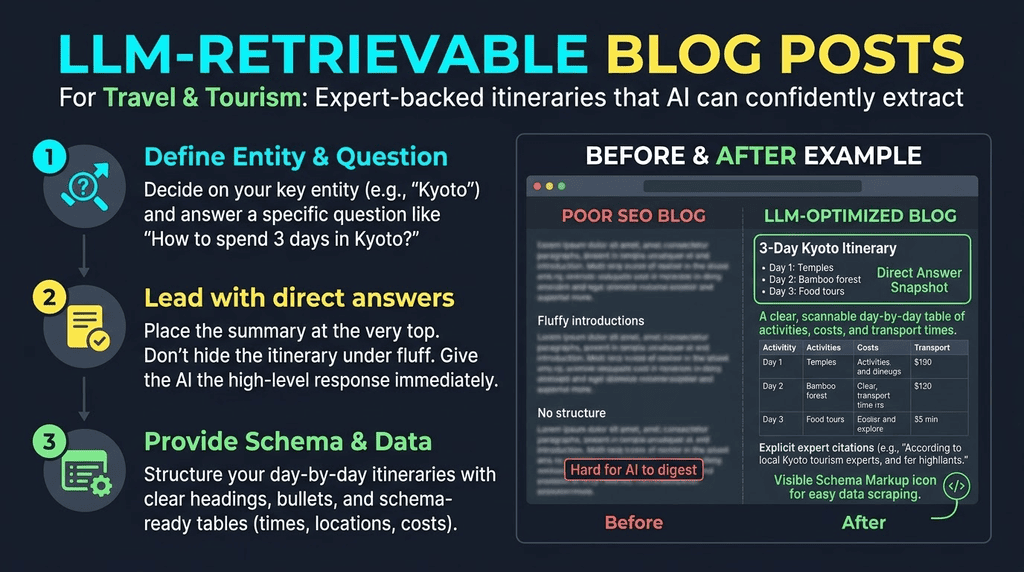
Most travel blogs open with 400 words about how Kyoto “captivates the soul.” Meanwhile someone asked an AI how to spend three days there. The page that wins opens with the three days.
Put a short day-by-day summary at the very top. Follow it with a table of activities, costs and transit times. Then name the person behind the advice. The graphic’s “according to local Kyoto tourism experts” is the weak version of that, so use a real name, a real credential and a real quote. The original GEO paper (Aggarwal et al., KDD 2024) found that adding quotations, statistics and cited sources can boost visibility in generated answers by up to 40%.
Support Article for AI Search
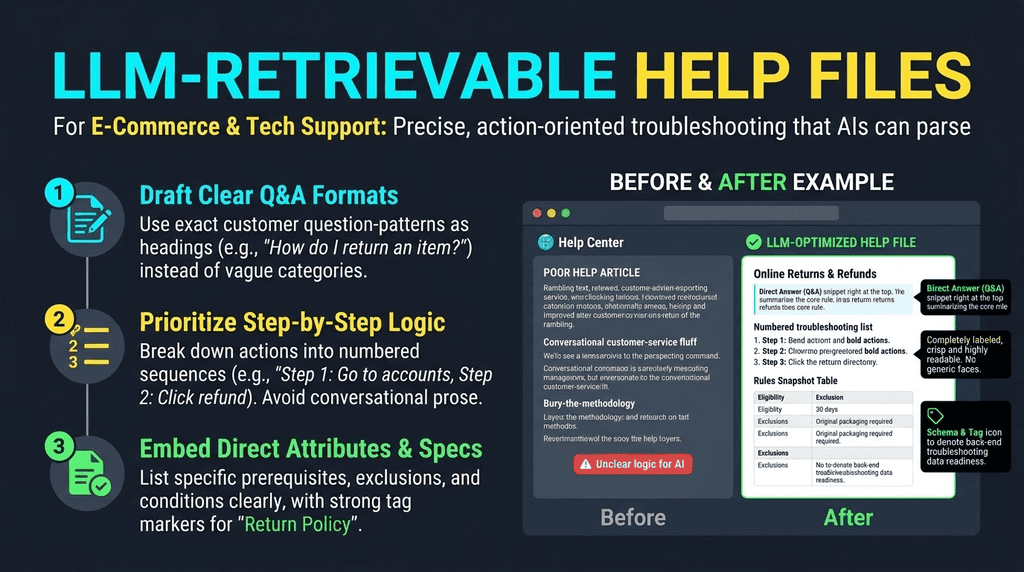
Help centers are where conversational prose goes to die. Nobody searching “how do I return an item” wants a paragraph about how much you value their feedback.
Use the customer’s exact question as the heading. Answer it in two or three sentences right underneath. Number the steps. Put eligibility and exclusions in a small table. For a workforce scheduling app, a good opening answer would read: “Employees can view the last synced schedule offline. Shift changes and swaps require a connection. The app updates the schedule when it reconnects.” Below it, list the app versions you tested and link to troubleshooting. Then have the product team verify every statement before release, because engines repeat what you publish.
Landing Page for AI Search
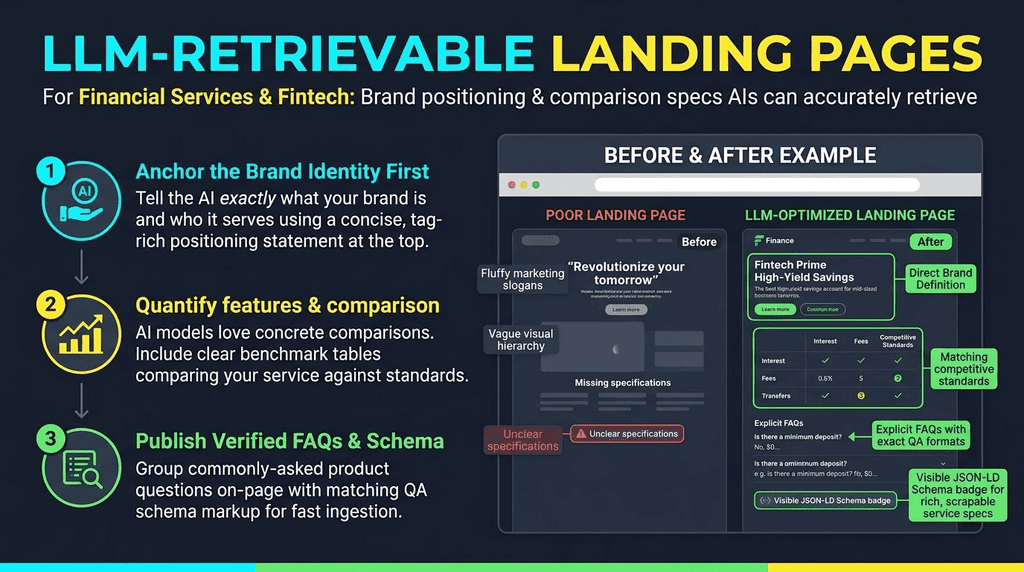
“Revolutionize your tomorrow” gives an engine nothing to quote. A landing page should state what the product is, who it serves and how it compares, in plain sentences near the top. You can also add a comparison table with real terms (rates, fees, minimums) and a visible FAQ that answers what people actually ask, like whether there’s a minimum deposit.
A caution, though. Every number on that page is a number an engine can repeat, so a stale rate becomes a wrong answer in someone else’s chat window.
Real-Life Example
Here is an example coming from HubSpot who grouped its target prompts by buyer stage and product line, then used the gaps to decide what to build. Discovery got a glossary with short definitions. Evaluation got industry-specific comparisons. Feature pages were rewritten around buyer questions, with FAQs, tables and lists. As a result, HubSpot reports 56% more AI citations on the updated feature pages and 433% more overall.
Now the warning. Those are HubSpot’s own numbers. It ran partner and community programs at the same time, and the write-up gives no timeframe and doesn’t split the 433% by tactic. Use the case to learn how to match a prompt to a page type. But don’t use it to forecast what your own feature pages will do.
The Content Audit You Should See in the First Month
By day 30 you should hold a page-level audit (don’t accept the crawl-level audit). This content audit should be a verdict on each priority page (keep, rewrite, merge or build new) with a reason tied to a question your buyers ask.
The graphic below shows the rubric I’d use. On the left, what gets flagged: intros that take 200 words to say nothing, claims with no source, answers buried mid-page. On the right, what earns a pass: headings that state the answer, original numbers the page owns, tables a machine can lift cleanly, a quote from a named expert, sources a reader can click.
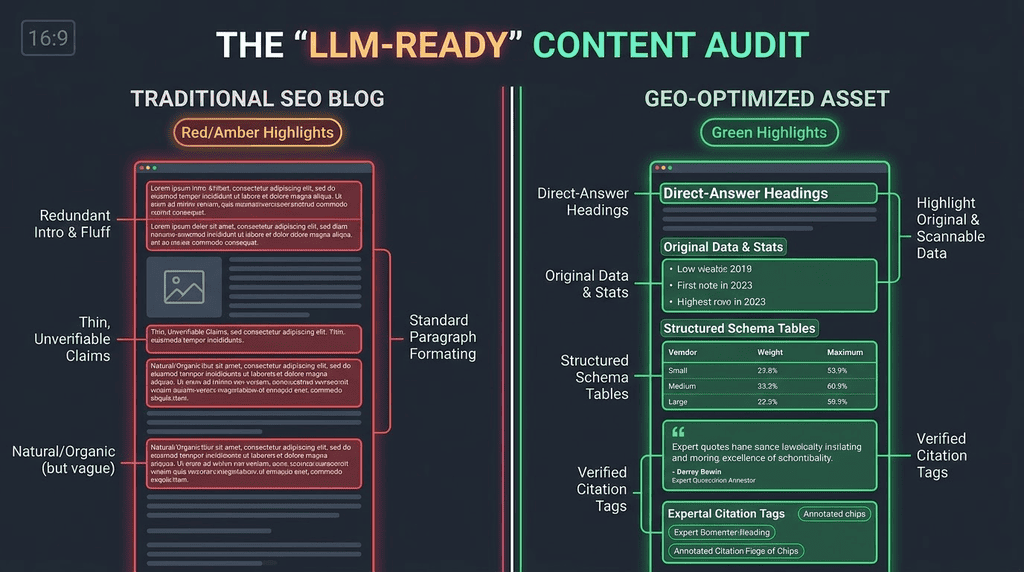
Two additions. First, the audit has to start from the prompt inventory, not from the page. A gorgeous page that answers a question nobody asks scores green on the rubric and does nothing for you. Second, most of what lands in the red column is simply bad writing. Readers hate it too. If an agency pitches “AI-friendly rewrites” and delivers shorter, sharper, better-sourced pages, that’s the right work. Just don’t pay a premium for the label.
How the Work Should Be Measured
The dashboard below is a mock-up, but you’ll recognize it. Citation share lines, sentiment gauges, a green number climbing up and to the right. Every agency demo has one. It looks great, and it can hide almost everything that matters.
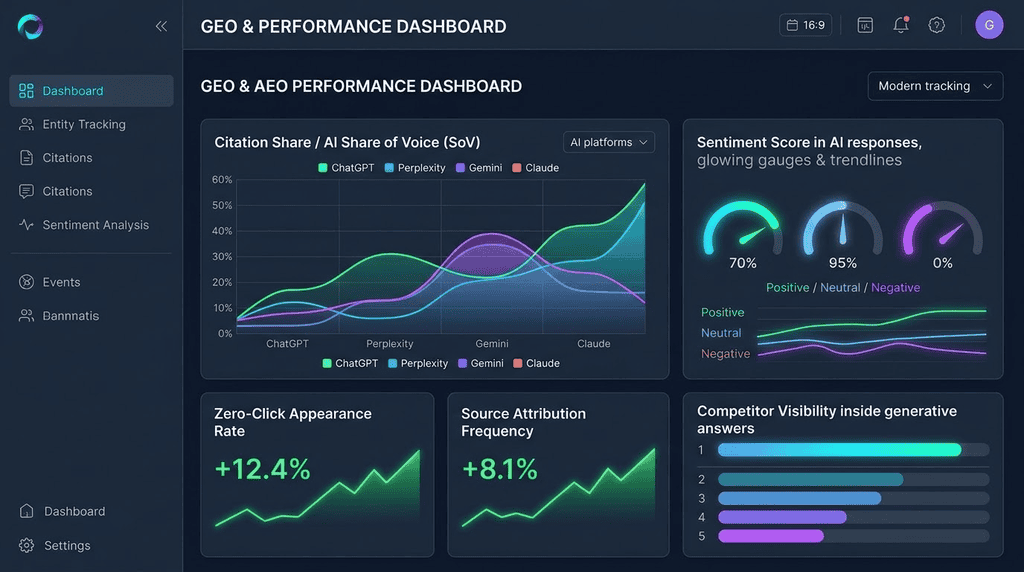
Start with the ground you’re standing on. Ahrefs tracked about 37,500 cited sites across five AI tools for 20 days. Depending on the tool, 50% to 83% of day-one citations were gone the next day. About 75% of the ones that vanished came back within the study window, and some of the “losses” were simply empty answers where the tool cited nobody. So it may take weeks for the data to settle down.
The engines also differ from each other. A study comparing Google organic search with five generative systems found substantial variation among engines in how much they lean on external sources and how diverse those sources are. It also noted that generative answers can vary across time and executions. Test each engine separately. A blended score can hide opposite trends on two of them.
Clicks aren’t the whole story here either. Adobe found that AI-referred visits to U.S. retail sites grew 71% year over year in September 2026 and earned 83% more revenue per visit than other traffic. That’s one month of U.S. retail data, and it doesn’t prove incremental revenue. It does say you should measure value, not just volume.
So ask for three views in every monthly report, with raw counts and sampling dates showing.
| View | What it tracks | Where it comes from |
|---|---|---|
| Sampled answers | Mention rate (answers naming your brand ÷ valid runs), own-domain citation rate, shortlist rate on unbranded prompts, accuracy against a dated list of approved claims | A fixed prompt panel with raw answers, citations, timestamps and mode settings |
| Platform activity | Google’s Search Generative AI performance reports in Search Console, and Bing Webmaster Tools’ AI Performance public preview (citation activity, cited URLs, sampled grounding queries) | First-party data in different units. Compare trends inside each source, never across them. Bing notes its counts reflect how often pages are cited, not their importance or placement. |
| Site and business outcomes | Attributable sessions, conversions, qualified leads and pipeline by landing page and source, plus a separate field for self-reported “found you through AI” | Analytics referrers and campaign tags, plus your CRM. Referrals only catch visits that can be detected. |
Here’s what an honest reporting line looks like: “For the payroll integration cluster on one engine, mentions rose from 8 of 30 to 14 of 30 valid responses.” That’s 26.7% to 46.7%, a 20-point gain, with the denominator in plain sight. (The example is illustrative.) Compare it with “AI visibility up 75%” and no denominator.
One published agency case shows why a single number misleads. For an HR software client, Bay Leaf Digital reported cited pages falling from 33 to 9 in July while total citations rose from 408 to 425. The total hid how narrow the wins had become.
The panel behind those numbers should be something someone else can rerun. For a pilot, that means 30 to 50 prompts from real buyer research, grouped by intent and run on two or three surfaces. Freeze the core set. Fix the country, language, mode and sign-in state. Run it on a set cadence and keep the answer text, screenshots and source URLs. Track branded and unbranded prompts separately. If nobody else can reproduce it, it isn’t a panel. It’s a screenshot.
Treat each content change as a test. Log publication and crawl dates, compare several equivalent windows, and where you can, leave a comparable group of pages untouched.
Before you talk to any agency, get a rough read on your own site. My AI visibility score is a free self-assessment that rates readiness across five areas: content structure, authority and trust signals, technical setup, answer-first writing, and freshness. It doesn’t measure what ChatGPT says about you (that’s the prompt panel’s job). What it does is show you which of the five areas to press an agency on first.
What It Costs and How to Scope the First 90 Days
The bill depends on what’s inside the package, so start there. A monitoring subscription shows you missing mentions and weak citations. A strategy project adds a diagnosis and a production plan. Managed execution adds the publishing, technical fixes, outreach and conversion measurement.
Two public price lists show how different the packaging gets. (U.S. dollars, reviewed in November 2026. They illustrate two models, not a market average.)
- WebFX lists an entry AI SEO plan at $3,000 a month on a six-month commitment, which is $18,000 over the term. It covers 50 prompts tracked across 10 AI answer engines, plus three “flexible assets” a month. Ask what an asset is and what it buys.
- Lean Labs lists an on-site AEO Launchpad from $12,000 one-time and an off-site Authority Build from $5,000 a month. Those are different starting scopes. Judge the tactics inside each against the platform guidance and the work you actually need.
I’d start with a 90-day pilot instead of a year-long retainer. This is the shape to ask for:
- Days 1 to 30: Agree on buyers, surfaces, prompts and competitors. Deliver a baseline export and a prioritized issue log. Sign off on metric definitions and ownership before anything gets published.
- Days 31 to 60: Fix the agreed technical blockers, update four to six priority pages, and start one external source initiative if it’s justified. Deliver live URLs, approvals and validation of each fix.
- Days 61 to 90: Rerun the baseline panel, compare the tested pages and prompts, review platform and conversion data, then hand over the exports, the change log and the next backlog.
Put the specifics in the contract. Name the engines and markets, the prompt count and run frequency, page and outreach volumes, who does editorial review, who implements, and what bills separately. Require access to the prompt library, raw exports, published assets and account data at handover. Treat any promised placement with suspicion. The engines decide it, and Google is blunt that indexing and serving aren’t guaranteed.
Red Flags, and What to Ask Instead
You can sort most proposals in a single meeting. Here’s what I’d listen for.
| If you hear | Ask |
|---|---|
| “We guarantee citations in ChatGPT.” | Which metric, which baseline, which window, and what’s the remedy if you miss? Placement is the engine’s call. |
| One blended “visibility” number and no raw data. | Show me the raw answers, the prompt list, the dates and the denominator behind it. |
| A case study with percentages and no counts. | What was the panel, what else changed during the period, and how was attribution handled? |
| Schema or an llms.txt file as the headline deliverable. | What does the rest of the scope cover? Google says it needs neither to show up in its AI features. |
| “We’ll handle everything.” | Who edits the pages, who verifies the facts, and who owns maintenance after launch? |
| Monitoring priced like strategy. | Which line items are delivery, which are advice, and which depend on someone else? |
| “Digital PR” and “reviews” blended into one line. | Can you report editorial placements, paid placements, review programs and corrections separately? |
One more, and it has no follow-up question. Fake reviews and seeded community posts are cheap, risky, and a good way to get your brand named for the wrong reasons. Walk away immediately if in doubt.
Here’s the final test. Before you sign, ask for the day-30 deliverables in writing: the baseline export, the issue log and the metric definitions. An agency that has done this before will say yes on the same call.